
| Book | Date and theme | Planning use |
|---|---|---|
| Nineteen Eighty-Four | Published 1949; power, propaganda, surveillance and organised deceit | The benchmark. Decide which of these four themes you want more of. |
| Animal Farm | Published 1945; Russian history from 1917 to 1943 as a farmyard allegory | Choose it for politics aimed at real history. |
| Brave New World | 1931; a vision that thrives on the loss of the individual | Choose it if selfhood mattered more to you than surveillance. |
| Fahrenheit 451 | Written in 1953; a society where it is illegal to own a book | Choose it for censorship and control of what people may know. |
| The Handmaid’s Tale | A theocratic military dictatorship builds a political system dependent on the subjugation of women | Choose it for state power exercised through law and gender. |
Dates and themes come from Pan Macmillan’s feature on Orwell’s two classics and the educations.com list of 1984 read-alikes.
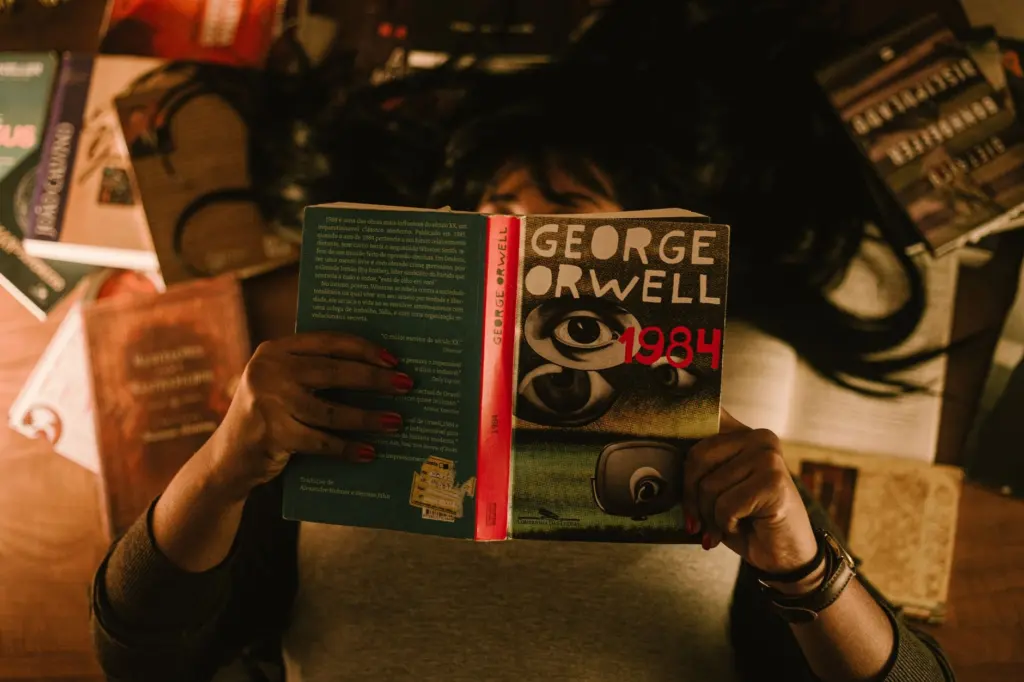
Books like 1984 work best when you match them to the theme you want more of: propaganda, censorship, the loss of the individual, or state law over private life.
If dystopia is only one of your reading moods, our guide to the best books to read covers other genres.
Choosing your next read by theme
The right follow-up depends on which part of Orwell’s novel stayed with you. Each choice below trades one strength of 1984 for another, so pick by what you want to keep.
- You want censorship and the fate of reading: Fahrenheit 451 puts the control of knowledge at the centre.
- You want the loss of the individual: Brave New World follows a society that thrives on it.
- You want law and gender as instruments of control: The Handmaid’s Tale builds a whole political system on the subjugation of women.
- You want a forerunner of Orwell’s world: We, from 1921, imagines free will effectively outlawed.
- You want politics tied to real events: Animal Farm retells Russian history as a farmyard allegory.
If you are still undecided, read in order of publication. That puts We (1921) and Brave New World (1931) before Nineteen Eighty-Four (1949), and Fahrenheit 451 (1953) after it. You then see how later writers answered Orwell and how earlier ones anticipated him.
Picks tied to 1984 themes
Brave New World: the individual erased
Huxley’s 1931 dystopian novel, in the words of educations.com, explores a futuristic vision that thrives on the loss of the individual. It is a dystopian social science fiction novel set in a World State, according to Goodreads. Choose it when the lasting idea from 1984 was what a society does to personal identity, and you care less about the machinery of surveillance. It is the natural companion if you like arguing about what a controlled society costs its members.
Fahrenheit 451: control of what people may know
Bradbury’s book imagines a world where it is illegal to own a book, and the title refers to the temperature at which books burn. It fits readers who finished 1984 thinking about thought control. One reading guide describes Orwell’s state as controlling not only behaviour but thought, and Bradbury attacks the same target through the destruction of books. Pick it when censorship and the fate of reading are your main interests.
The Handmaid’s Tale: state power through law
Atwood’s novel takes place after a theocratic military dictatorship has overthrown the US government and implemented a political system dependent on the subjugation of women, as the educations.com list summarises it. It suits readers who found 1984 most convincing when it showed rules shaping daily life. Choose it over the others if you want power explored through gender and legal structure rather than through technology or propaganda alone.
We and 2084: the older and newer echoes
Zamyatin’s We is a 1921 dystopian novel by a Russian writer, and the earlybirdbooks guide places it in a future where free will has effectively been outlawed and humans are reduced to numbers. Read it if you like tracing where Orwell’s ideas came from. For a more recent echo, the same guide points to a tribute titled 2084, set in a caliphate that forbids deviation of any kind and where remembering the past is forbidden. Both suit readers drawn to 1984’s rewriting of memory.

Which is most political?
Animal Farm is the most directly political companion, because it turns Russian history between 1917 and 1943 into a farmyard allegory, as Pan Macmillan describes it. Orwell published it in 1945, before Nineteen Eighty-Four, so it works as a short route into his politics. Among the other picks, The Handmaid’s Tale is the one that most explicitly describes a political system, and Fahrenheit 451 is political in a narrower way, about what a state lets citizens read.
Choose Animal Farm if you want argument pinned to real events. Choose The Handmaid’s Tale if you want the workings of a regime. Choose Brave New World if you want politics as a question about people rather than institutions.
What 1984 sets as the benchmark
Pan Macmillan lists the range of Orwell’s interests in Nineteen Eighty-Four as power, propaganda, surveillance and organised deceit. It also points out that the first persuasive study of the totalitarian mindset was a novel, not a non-fiction work. That is why a read-alike has to earn the comparison by pursuing at least one of those themes with similar seriousness.
The earlybirdbooks guide adds that Orwell’s state polices thought through relentless propaganda, reeducation and historical revisionism. Treat that as a checklist when you weigh a recommendation. A book that only borrows a bleak setting will feel thin after Orwell, while one that pursues even a single of these themes will feel related.
When to pause the dystopias
Several of these books are bleak, and back-to-back reading can blunt their effect. If you want a change of pace afterwards, What Is a Cozy Mystery? The Beginner’s Guide to Charming Whodunits (2026) introduces a gentler genre. For something more escapist, Lose Yourself In Magic And Love: The Best Romantasy Books To Read In 2026 collects fantasy-romance picks.
Frequently asked questions
Is Nineteen Eighty-Four a novel or a non-fiction study?
It is a novel, published in 1949. Pan Macmillan notes that the first persuasive study of the totalitarian mindset was a novel rather than a non-fiction work.
What kind of book is Brave New World?
It is a dystopian social science fiction novel by the English author Aldous Huxley, set in a World State, according to Goodreads.
How can a library help me find more books like 1984?
A Manatee County library guide to read-next websites describes a tool where you enter an author you like and see a visual map of similar authors. It also lists LibraryReads, a monthly list of top fiction and nonfiction curated by librarians across the U.S.